
Book Feature – From Dakota to Dixie: George Buswell’s Civil War
From Dakota to Dixie: George Buswell’s Civil War
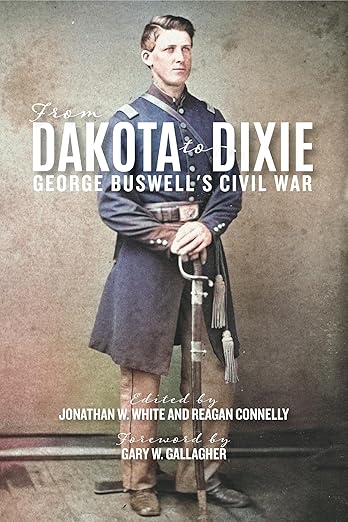
Edited by Jonathan W. White and Reagan Connelly
Foreword by Gary W. Gallagher
University of Virginia Press | April 9, 2025
A Nation Divided: Studies in the Civil War Era
From Dakota to Dixie: George Buswell’s Civil War is a newly published edition of the Civil War–era diaries of George W. Buswell, a Minnesota soldier whose service carried him from the U.S.–Dakota War of 1862 into the Western Theater of the Civil War and, later, into the officer ranks of a United States Colored Troops regiment. Edited by historian Jonathan W. White and Reagan Connelly, the volume makes available—many for the first time—Buswell’s detailed, near-daily observations from 1862 to 1864.
I have not yet had the opportunity to read this book in full, but it stands out as a valuable primary-source resource for readers interested in Minnesota history, the Civil War beyond its eastern battlefields, and the often-overlooked intersections between the Civil War and U.S.–Dakota conflict.
Buswell enlisted in the Union army in the summer of 1862 expecting to fight Confederates. Instead, he was assigned to the 7th Minnesota Infantry and deployed during the U.S.–Dakota War. His diary documents this period from the perspective of a rank-and-file Union soldier who, by his own admission, had little desire to participate in that conflict but nonetheless became part of it. Of particular historical significance is Buswell’s eyewitness account of December 26, 1862, when thirty-eight Dakota men were hanged in Mankato—an event that remains the largest officially sanctioned mass execution in United States history.
According to the editors, Buswell’s entry for that day follows the pattern of many of his diary entries, beginning with a brief note about the weather before describing the construction of the gallows and the execution itself. The matter-of-fact nature of the account, typical of military diaries of the period, makes it an important contemporaneous record of an event that continues to shape historical memory and public discussion in Minnesota and beyond.
The diary continues through late 1864. After his service in Minnesota, Buswell sought advancement by becoming an officer in the 68th United States Colored Infantry. In this later phase of the diary, he records his experiences in the Western Theater of the Civil War, including campaigns in Mississippi and service against Confederate forces under Nathan Bedford Forrest. Taken as a whole, the diary traces a military career that moved across geographic, racial, and political boundaries central to understanding the broader Civil War era.
White and Connelly have framed Buswell’s diary with short introductory essays, extensive footnotes, and maps designed to help modern readers situate his daily observations within their larger historical context. The volume is part of the University of Virginia Press’s A Nation Divided series, which focuses on new scholarship and primary sources from the Civil War era.
For historians, students, and general readers—particularly those interested in Minnesota’s Civil War experience, the U.S.–Dakota War of 1862, and the role of Union soldiers in both Indigenous conflict and emancipation—From Dakota to Dixie appears to offer a significant and accessible primary-source window into a complex and often uncomfortable past.
Why this book may interest Minnesota readers
From Dakota to Dixie offers Minnesota readers access to a rare contemporaneous account of events that continue to shape the state’s historical memory. George Buswell served with the 7th Minnesota Infantry during the U.S.–Dakota War of 1862, and his diary includes an eyewitness description of the mass execution of thirty-eight Dakota men at Mankato on December 26, 1862. As a primary source, Buswell’s matter-of-fact recording of that day provides insight into how soldiers understood—and normalized—extraordinary violence at the time.
Beyond Mankato, the diary documents the experiences of a Minnesotan whose Civil War unfolded far from the battlefields most commonly associated with the conflict. Buswell’s later service as an officer in a United States Colored Troops regiment connects Minnesota’s wartime story to larger national questions about emancipation, military service, and the meaning of Union victory. For readers seeking firsthand perspectives rather than retrospective interpretation, this volume offers an important window into Minnesota’s place within the broader Civil War era.
Sources:
Kelly-Fischer, Patrick. “Book Review: From Dakota to Dixie: George Buswell’s Civil War – Emerging Civil War.” Emerging Civil War. August 7, 2025. https://emergingcivilwar.com/2025/08/07/book-review-from-dakota-to-dixie-george-buswells-civil-war/.
Michael Lagerquist. “Diaries of Civil War Soldier Provide Insight to Events of the Time.” Mankato Free Press. April 20, 2025. https://www.mankatofreepress.com/diaries-of-civil-war-soldier-provide-insight-to-events-of-the-time/article_7b18a0b4-2fab-45f4-88d9-91a19f1b3e2e.html.